Empieza aquí
Acerca de
Hablando
Contáctenos
Únete a la mesa
Curso para padres
Recursos
Spanish
Order my debut book! - 5 Habits of the Tech-Ready Family 📑


.webp)
Whether you are 4, 14, or 40, there’s a combination of elements that cause us to make poor digital decisions. At Protect Young Eyes, we call it the Toxic Trio: Bedrooms, Boredom, and Darkness. Anytime you combine these elements with a device, you increase the risk of bad digital choices. Kids more often find themselves in a “toxic trio” situation over breaks, on long weekends, and during summer vacation. When routines disappear, risk often rises.
We’re going to break this down, because avoiding the Toxic Trio isn’t fear-based parenting. Rather, it’s knowing how our amazing kids, the risk of temptation, and human nature work.
In a survey of 150 high school students conducted by a Diocese we worked with, we found the following:
🔵 61% said they consumed pornography in their bedrooms, more than twice any other location.
🔵 48% said they were feeling bored just before watching.
🔵 20% identified loneliness as the emotion they felt just before deciding to look at porn.
Those numbers aren’t shocking when you consider the environment. Bedrooms are private. Boredom lowers resistance. Darkness dulls discernment. And a personal device creates the illusion: no one will know.
When devices move behind closed doors, accountability disappears. We make better decisions in shared spaces. The 5 most dangerous places for kids to be online are:
(We’ve just added a #6 - BASEMENTS! Having rules in the basement is really important!)
Whenever possible, we want to be present and nearby when kids are online. These 6 places often have different digital rules (grandparents’ house), less adult attention (school bus), or less adult presence (bedrooms, bathrooms, basements, sleepovers). These factors result in higher digital risks.
We don’t want our kids to be alone with tech in these places, not because we don’t trust them, but because we understand human nature. Adults struggle with this, too.
Boredom is often viewed as a problem, but really, it’s an opportunity for us to grow.
When a child is bored, their brain looks for stimulation. If we’ve trained it to expect instant digital reward, that’s where it will want to go. But boredom can also lead to creativity, outdoor play, reading, music, deep thinking, and faith development.
For example, Neuroscientist Alicia Walf, a researcher in the Department of Cognitive Science at Rensselaer Polytechnic Institute, explains that allowing yourself to feel bored occasionally is important for brain health. When your mind isn’t constantly engaged or overstimulated, it finally gets a chance to rest.
In those quiet moments that may seem unproductive, ideas and solutions that have been forming beneath the surface suddenly have room to emerge.
Many well-known writers have shared that their best ideas show up while doing simple activities like rearranging furniture, taking a shower, or pulling weeds in the garden. These sudden flashes of understanding lead to moments of insight.
We know that busy people don’t have epiphanies. And our kids won’t have them either if their brains aren’t ever confronted with boredom.
Many are often alone with their devices at night. In their bedrooms, where things feel most private. However, privacy can often increase risk-taking. Whether someone is 14 or 40, almost anything can feel justified at 11:30 pm on a screen.
According to data from one of the most popular pornography sites, time spent watching porn spikes at night. Specifically on Sunday nights.
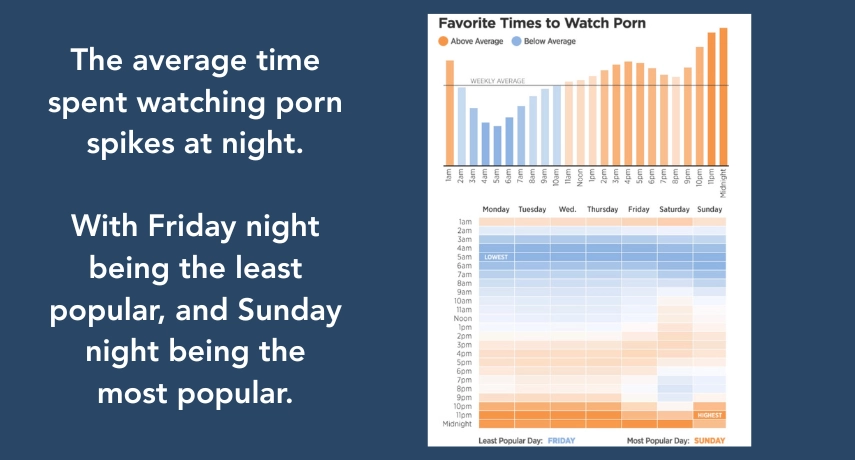
So, it’s best we avoid being on our devices at night. This keeps us away from harmful temptations, binge watching, doomscrolling, and being on screens at night often impacts sleep as well.
Even if your child already has a phone, the Toxic Trio gives you a framework: delay privacy with devices. Delay unrestricted access. Delay late-night scrolling. Delay social media.
Because we are asking our children to exercise a level of self-control most adults still struggle with. And breaks, when schedules disappear, are prime time for temptation.
Here are simple, high-impact shifts:
✅ Devices charge outside bedrooms (here’s a great docking station)
✅ No screens after a set evening time (a good router can help)
✅ Filters and monitoring software on every device (check our Device Guides)
✅ Clear expectations about boredom (it’s not the enemy!)
✅ 10 conversations about pornography before age 10 (make porn a more “normal” talk)
If you’re reading this and feeling behind, take a breath. We all make better digital decisions when we avoid the Toxic Trio, adults included.
Your child doesn’t need unlimited privacy with a powerful device. Your boundaries. Your presence. Your calm. They need you!

¡Dos acciones que puedes tomar!
Lea sobre el compromiso de nuestro equipo de proporcionar a todos los usuarios de nuestra plataforma global la tecnología que puede ayudarlos a avanzar.
Es un honor unirme a Bark y a otros increíbles defensores en esta película.
Se unió a una coalición de expertos mundiales para presentar sobre los daños de las redes sociales.
Compartimos nuestra investigación y experiencia con el Comité Judicial del Senado de los Estados Unidos.



%20(1).webp)